Most buyers walking into a Naples home for the first time bring a certain set of assumptions with them, and one of the more stubborn ones is that older houses are mold houses and newer construction is somehow safer. That makes intuitive sense if you’ve never actually spent time inside the building science of how moisture moves through a structure. It’s also wrong, and in Naples specifically it’s wrong in a way that costs people real money. Some of the homes we see develop mold problems fastest, after a power outage or an AC failure, are the brand-new high-end builds downtown with every modern feature the market currently rewards. And some of the homes we see hold up best through the exact same conditions are the older Florida-built places that the market has spent decades treating as second-class.
This article is for the buyer who’s about to put an offer on a Naples home and wants to understand what they’re actually signing up for. The short version is that mold isn’t about how old a house is, it’s about how the house manages moisture when something in the building stops behaving the way it was designed to behave. The full version is worth understanding before you close on anything in this market.
How an Older Florida Home Manages Moisture
The Florida homes built before air conditioning became universal were designed for the climate the builder was actually standing in. Ceilings were high, because hot air rises and you wanted somewhere for it to go. Windows opened on multiple sides of every room, often with cross-ventilation built into the floor plan, so air moved through the house even on still days. Materials were often more breathable than what we use now, with real wood and plaster doing a lot of the work that drywall and paper-faced gypsum do today. The roof had a proper vented soffit and a hot vented attic that drew air through the assembly continuously. None of this was efficient by modern standards. Conditioning the inside of one of these homes is expensive, because you’re constantly fighting the air exchange the building was designed to encourage.
But that same air exchange is the reason an older Florida home is harder to grow mold in than people think. Mold doesn’t grow because of high relative humidity in the air, it grows because of sustained moisture on a surface, sitting there long enough for spores to colonize organic material like drywall paper. In a house where air is constantly moving, even at higher ambient humidity, that surface moisture doesn’t get the chance to sit. Breezes break up the boundary layer of damp air against walls and floors. Vented attics keep the underside of the roof deck dry. The whole building behaves like it’s slowly exhaling all the time. That’s why those homes operated for decades without obvious mold issues, which is both the phrasing from building science research and the consistent observation of every inspector who’s worked older Florida stock.
What Changed in Modern Construction
The Naples market has been pushing tight, energy-efficient construction hard for the last fifteen or twenty years, and the high-end downtown builds going up right now represent the most extreme version of it. Impact-rated windows and doors seal against air infiltration so tightly that you can feel the pressure difference when you open the front door. Spray foam insulation, applied directly to the underside of the roof deck, eliminates the vented attic entirely and turns the attic space into part of the conditioned envelope. Modern house wrap and flashing details cut down on the bulk air leakage that older homes had through their walls. Mechanical ventilation, in the form of an HRV or ERV, is supposed to bring in exactly the amount of fresh air the home needs and no more, exchanging stale interior air for filtered exterior air on a controlled schedule.
On paper this is a more comfortable, more efficient, more storm-resistant building. And when every system is running the way the engineer drew it, it actually is. The air conditioner pulls humidity down to the target setpoint, the ERV trickles in fresh air at a rate that doesn’t overwhelm the dehumidification, and the conditioned envelope stays in a tight comfort band regardless of what’s happening outside. The problem isn’t the design, the problem is what the design depends on.
The Failure Scenarios Most Buyers Don’t Think About
Every piece of the modern moisture management strategy is active. The AC has to be running. The ERV has to be set correctly. The power has to be on. The condensate drain has to be clear. Take any one of those out of service and the home has no passive backup, because the features that used to provide passive backup, like ventilated attics and operable windows and breathable walls, were intentionally engineered out in the name of efficiency.
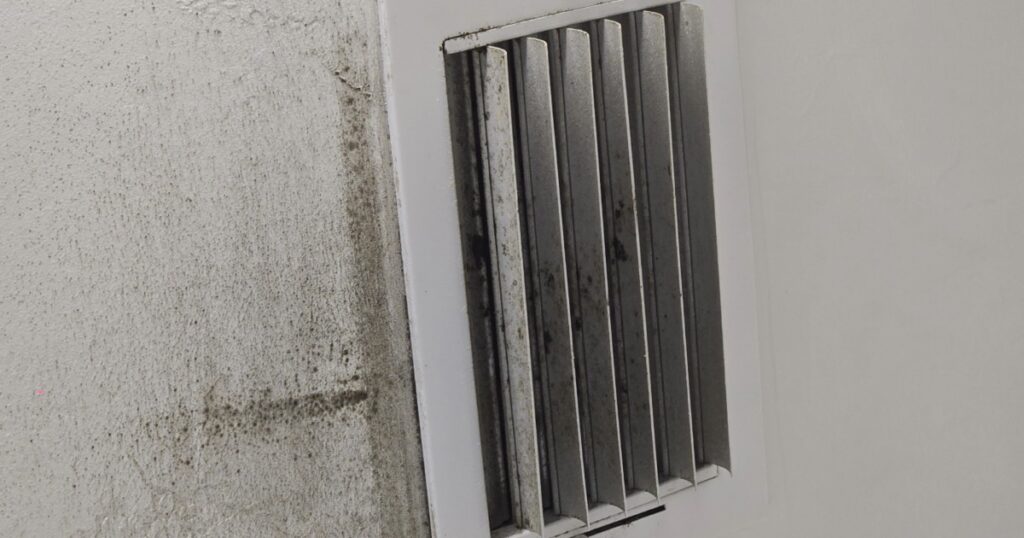
We see a few specific failure scenarios in Naples that buyers should know about before they sign. The first is straight AC failure during the hot half of the year. A compressor goes out, a refrigerant leak develops, the unit ices over, the cause doesn’t really matter. Inside the home, indoor humidity climbs fast because nothing is pulling it down anymore. Within twenty-four to seventy-two hours, depending on outdoor conditions, surfaces inside the home can hit dew point and start condensing moisture. Drywall, baseboards, cabinet interiors, the back side of wall art, anywhere with a temperature gradient becomes a candidate site for mold colonization. Visible growth can start within a few days and turn into a real remediation job inside of a week.
The second is the hurricane power outage. This one matters more in Naples than anywhere else we work, because we get them regularly. Power goes out, AC goes off, ERV goes off, and the home enters the same failure state as an AC breakdown except potentially for days at a time. The homes that come out of an extended power outage worst are exactly the tightest, most modern, highest-end builds. They were designed to never need passive ventilation, so they don’t have any when the mechanical systems stop. Visible mold growth can show up before the homeowner is even back from evacuation, and full drywall replacement in multiple rooms isn’t an unusual outcome from a single multi-day outage.
The third is operator error, which is gentler but more common. Homeowners often dial down their ERVs because they don’t want to pay to condition humid Gulf air that the unit is intentionally bringing inside. The ERV is doing its job. The owner thinks it’s making the house feel worse, so they turn it down. Now the home has no fresh air exchange at all, the AC is running but only against the moisture that’s already inside, and indoor humidity slowly creeps up over weeks or months. The mold problem that develops out of this scenario isn’t dramatic. It’s a slow accumulation in the corners of closets, behind furniture, around bathroom vents, the kinds of places homeowners don’t look until something starts smelling.
Why This Matters Specifically in Naples
A few facts about our market stack the deck against modern construction in a way they don’t elsewhere. We’re in a humid subtropical climate, so the outdoor dew point sits high for most of the year and there’s an enormous reservoir of moisture waiting to enter any building that loses its conditioning. Hurricane season means multi-day power outages are a planning assumption around here, not a freak event. A meaningful share of properties sit empty for months at a time because this is a second-home market, often with their systems set to minimum and nobody checking on them. And the high-end neighborhoods downtown and along the coast are being built tighter every year as energy codes ratchet up.
Put all of that together and you get a category of homes that are wonderful to live in when everything is running, and uniquely vulnerable when something stops. The older homes in the same market have their own issues, and we’re not pretending otherwise. Drafty original windows cost money to condition. Roof systems that predate modern underlayment fail in ways the new ones don’t. There’s a reason builders moved toward tight construction in the first place. But on the specific question of mold risk in failure scenarios, the older Florida-built houses around here just hold up better than people think, and the new ones hold up worse than they look.
What a Buyer Should Actually Ask Before Closing
If you’re putting an offer on a modern Naples home, especially a tight high-efficiency build, here’s what’s worth knowing before you close. Ask what kind of ventilation system the house has. If it has an ERV or HRV, ask if it’s been serviced and what setting the seller has been running it at. Ask about the AC, but specifically ask whether the system has any kind of standalone dehumidification beyond the AC itself, because a properly sized dehumidifier is the single best insurance policy against the failure scenarios we just walked through. Ask whether the attic is sealed with spray foam or traditionally vented, because that changes the moisture risk profile of the whole home. And ask whether the home has a generator with an automatic transfer switch, because in our market that’s not just a comfort feature, it’s a mold prevention feature.
For an older home, the questions are different. You’re looking at whether the existing breathability has been preserved or compromised by previous renovations. A 1960s Naples cottage that’s been retrofitted with new tight windows but still has its original vented attic might be in a sweet spot. The same cottage with closed-off soffits and unvented additions might be worse than either pure version. The wrong half-renovation can create exactly the same trapped-moisture problem as a brand-new tight build.
In either case, the inspector you hire should be able to walk you through what they’re seeing in the building envelope and what the moisture management strategy of the home actually is, system by system. If they can’t, you don’t have the full picture. The broader conversation about what an inspector’s job actually covers, and where it ends, what a Naples home inspector actually does, for buyers trying to make sense of the inspection process.
A Quick Word for Existing Homeowners
If you already own a tight modern Naples home, the practical operating advice is shorter than the buying advice. Don’t dial down the ERV, set it where the installer recommended and leave it. Make sure your AC is serviced before storm season and know the symptoms of a system that’s losing capacity, because catching it on day one is the difference between a service call and a remediation job. If you’re a seasonal owner, consider a Wi-Fi-enabled humidity monitor or a remote thermostat with humidity alerts, because the worst version of this story is the empty-house scenario where nobody’s around to notice the AC died in July. And take generators seriously, because in Naples a generator isn’t really about comfort, it’s about not coming home to a mold problem after a storm.
The buyers and homeowners we work with who understand this stuff make better decisions, both about which homes to buy and about how to operate the ones they own. The market hasn’t fully caught up to the building science yet, and the standard real estate narrative still treats new as automatically better than old. The honest version is that new is better in a lot of ways, but worse in this specific way, and worth knowing about before you’ve signed the closing documents.