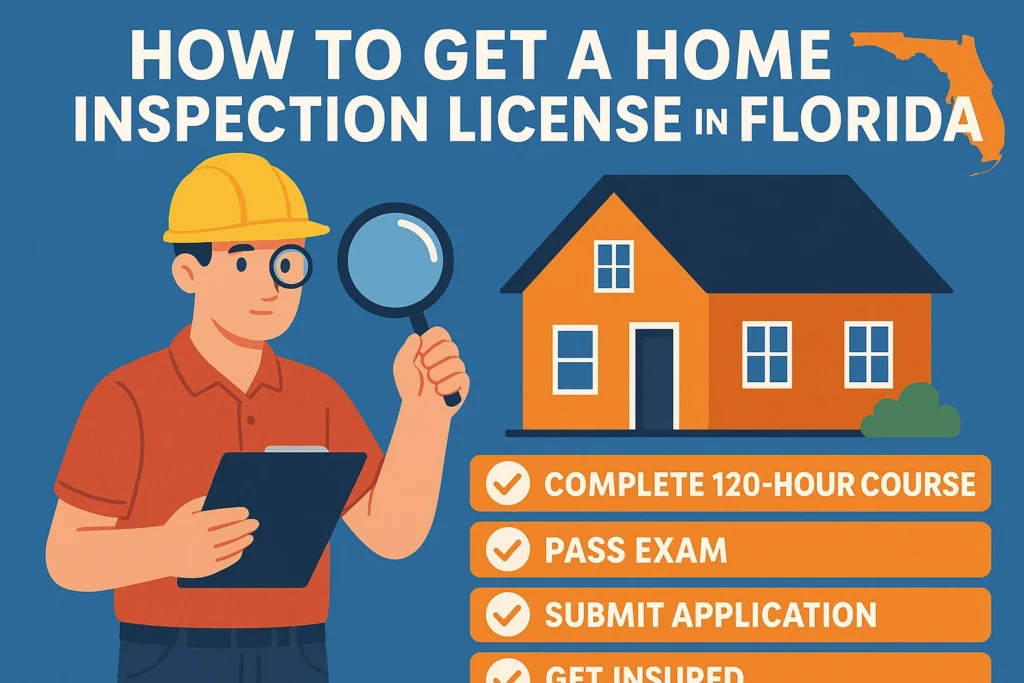
Becoming a licensed home inspector in Florida is a rewarding career path for those interested in the real estate, construction, and property evaluation sectors. Whether you’re transitioning from construction or beginning a new profession, knowing how to get a home inspection license in Florida is crucial.
The Florida Department of Business and Professional Regulation (DBPR) oversees the licensing process, requiring applicants to meet specific education, experience, and examination criteria. This article provides a detailed, step-by-step guide on how to become a licensed home inspector in Florida, including training requirements, application process, costs, and tips for long-term success.
Let’s explore everything you need to know to launch your home inspection career in the Sunshine State.
How to become a home inspector in Florida?
Thinking about a career in home inspection? Florida is one of the best states to launch this profession, thanks to its booming real estate market and regulatory structure. If you’re wondering how to become a home inspector in Florida, this guide covers everything—education, licensing, exams, and business setup.
In Florida, home inspectors are licensed professionals who assess the condition of residential properties. They identify potential issues such as foundation cracks, roofing problems, plumbing leaks, electrical hazards, and more. This role is crucial during the home-buying process, as inspectors help clients make informed decisions.
Whether you’re transitioning from construction or starting a fresh career, becoming a certified home inspector in Florida can be both fulfilling and lucrative. Let’s explore the requirements, training, costs, and tips that will help you get started.
Who Needs Home Inspection Licensing?
In Florida, anyone who performs home inspections for compensation is legally required to obtain a home inspection license. This includes individuals who evaluate the condition of residential properties as part of real estate transactions, insurance assessments, or general property evaluations. Licensing is mandated under Florida Statutes Chapter 468, Part XV, which defines a home inspector as a person who conducts visual examinations of a home’s structure, systems, and components and provides a written report of the findings.
This requirement applies not only to independent inspectors but also to those employed by home inspection companies. Whether you are self-employed or working as part of a larger organization, if your job involves conducting home inspections for pay, you must hold a valid license issued by the Florida Department of Business and Professional Regulation (DBPR).
There are, however, some exceptions. For example, licensed general contractors, building code administrators, architects, and engineers may be exempt if they are performing inspections within the scope of their existing licenses. But for those who strictly operate as home inspectors and are not covered under these professional licenses, obtaining a home inspection license is a legal necessity to operate in Florida.
Florida Home Inspector License Requirements
To legally work as a home inspector in Florida, you must obtain a license from the Florida Department of Business and Professional Regulation (DBPR). This ensures consumer protection and professional standards across the industry.
Here are the key requirements:
- Age: You must be at least 18 years old.
- Education: A high school diploma or equivalent is required.
- Training: Complete a state-approved home inspector course (120 hours).
- Exam: Pass the National Home Inspector Examination (NHIE).
- Background Check: Submit fingerprints for a criminal background check.
- Insurance: Provide proof of general liability insurance ($300,000 minimum).
- Application: Submit your application and pay the $125 state licensing fee.
This framework ensures that only qualified professionals conduct inspections in Florida homes. Each requirement plays a role in preparing you for both the technical and legal aspects of the job.
Florida Home Inspector Licensing Examination
The Florida Home Inspector Licensing Examination is a critical step for anyone seeking to become a licensed home inspector in the state. Administered by the Department of Business and Professional Regulation (DBPR), this exam evaluates a candidate’s knowledge of residential property systems, components, and the standards of practice required for professional inspections in Florida.
To qualify for the exam, applicants must first complete a DBPR-approved 120-hour pre-licensing education course covering topics such as roofing, plumbing, HVAC, structure, electrical systems, and Florida-specific regulations. The exam itself is composed of multiple-choice questions and typically includes around 100–120 questions, with a passing score of 70% or higher. It is designed to ensure that prospective inspectors understand how to evaluate a home safely, legally, and effectively.
Once passed, the exam score can be submitted as part of the licensing application process. Completing the Florida Home Inspector Licensing Examination not only fulfills a legal requirement but also demonstrates professional competency and readiness to serve clients with integrity and knowledge.
Home Inspection State Licensing
Home inspection state licensing refers to the regulatory process established by individual U.S. states to ensure that professionals conducting home inspections are qualified, knowledgeable, and capable of performing reliable evaluations of residential properties. In Florida, this licensing is governed by the Florida Department of Business and Professional Regulation (DBPR) under Chapter 468, Part XV of the Florida Statutes. The state mandates that anyone performing home inspections for a fee must hold an active home inspector license. This requirement helps maintain public safety, promote consumer protection, and establish industry standards.
To obtain a Florida home inspection license, applicants must meet specific educational and testing requirements. This includes completing a DBPR-approved 120-hour training course that covers major structural systems such as electrical, plumbing, roofing, HVAC, and foundations. After completing the course, the individual must pass the Florida Home Inspector Licensing Examination, which tests practical knowledge and understanding of the standards of practice. Once passed, applicants must submit fingerprints for a background check, demonstrate financial responsibility, and apply for licensure through the DBPR system.
It’s important to note that licensing requirements vary from state to state. While Florida has a comprehensive licensing process, some states may require additional certifications, continuing education, or insurance coverage such as general liability and errors and omissions (E&O) insurance. Others may have no formal licensing at all, relying instead on voluntary certification from industry organizations. Therefore, anyone considering a career in home inspection must research the licensing standards in their specific state to ensure full compliance with legal and professional expectations.
Florida Home Inspector License Online
Obtaining a Florida home inspector license online is a convenient and efficient option for aspiring professionals looking to enter the home inspection industry. The Florida Department of Business and Professional Regulation (DBPR) allows candidates to complete the required pre-licensing education through approved online training providers.
These courses typically cover key topics such as building systems, roofing, plumbing, electrical systems, and report writing. Once you complete the required 120 hours of coursework online, you must pass the National Home Inspector Examination (NHIE).
After passing the exam, you can apply for your license through the DBPR’s online portal by submitting proof of education, examination results, fingerprints for a background check, and the appropriate fees. The online process offers flexibility, allowing you to study at your own pace and apply without the need to visit a physical office, making it an ideal choice for working professionals or those with busy schedules.
Florida DBPR Home Inspector License
The Florida Department of Business and Professional Regulation (DBPR) is the state agency responsible for licensing and regulating home inspectors throughout Florida. To obtain a Florida DBPR home inspector license, applicants must meet several specific requirements, including completing at least 120 hours of approved pre-licensing education, passing a state-approved home inspection examination, and submitting a license application along with the required fee.
Additionally, applicants must be at least 18 years old and possess a high school diploma or equivalent. Once licensed, home inspectors must adhere to Florida’s standards of practice and code of ethics, as well as complete continuing education every two years to maintain active licensure. The DBPR ensures that only qualified individuals can offer home inspection services, helping to protect consumers and promote professionalism in the industry.
Conclusion
Securing a home inspection license in Florida is a structured yet rewarding process that opens the door to a fulfilling career in real estate and property evaluation. By meeting the Florida Department of Business and Professional Regulation (DBPR) requirements—including completing 120 hours of approved training, passing the Florida Home Inspector Licensing Examination, undergoing a background check, and submitting the necessary application and fees—you position yourself as a qualified and trusted professional in a growing industry.
Whether you choose to complete your training in-person or online, the steps are designed to ensure that you are fully prepared to carry out inspections with competence, accuracy, and integrity. Once licensed, maintaining compliance through continuing education and adherence to the state’s ethical guidelines will help you build a successful and reputable home inspection career.
FAQS
1. Can I use my military experience to fulfill any home inspector licensing requirements in Florida?
Yes, the Florida DBPR offers accommodations for military personnel, veterans, and their spouses under the Military Licensing Program. Relevant experience in engineering, construction, or building inspection gained during military service may be reviewed for potential equivalency to state licensing requirements. Additionally, application fees may be waived or reimbursed for qualifying military applicants.
2. How long does it take to get a home inspection license in Florida from start to finish?
The timeline varies depending on your pace, but generally, it can take 2 to 4 months to become licensed. This includes time to complete the 120-hour education course (which can be done faster if taken full-time), schedule and pass the NHIE exam, complete fingerprinting, gather documents, and submit the application. Online programs and fast-track scheduling can help speed up the process.
3. What kind of continuing education is required to maintain a Florida home inspection license?
Licensed Florida home inspectors must complete 14 hours of continuing education (CE) every two years to renew their license. The CE must be completed through DBPR-approved providers and typically includes updates on building codes, ethics, safety practices, and changes in inspection laws. Failure to complete CE requirements can lead to license suspension or revocation.
4. Can I perform home inspections in other states with a Florida license?
Not directly. While a Florida home inspection license is valid only within the state, some other states may recognize your Florida education or examination under reciprocity agreements or alternative licensure paths. However, each state has its own requirements, so you must check with that state’s regulatory board to determine if any part of your Florida licensure can be transferred or applied.
5. Do I need specialized tools or software to start working as a home inspector in Florida?
Yes, while not required by the DBPR, it’s highly recommended to invest in essential tools such as moisture meters, infrared thermometers, ladders, electrical testers, and inspection report software. Many home inspectors also use drones or thermal imaging cameras to enhance inspections. Having the right tools not only improves inspection quality but also boosts your professionalism and client trust.
Home Inspection Services Across Florida
PatriotInspect delivers certified, trusted, and location-specific inspection services across Southwest Florida and Miami-Dade County.
Four Point Inspection – Fort Myers
Insurance-focused inspection for roofing, plumbing, electrical, and HVAC systems.
Home Inspection – Fort Myers
Complete home inspection services for buyers, sellers, and homeowners.
Mold Inspection – Fort Myers
Professional mold inspections for moisture-related issues and indoor air quality.
Wind Mitigation – Fort Myers
Identify wind-resistant features that may help reduce insurance premiums.
Home Inspection – Cape Coral
Certified and trusted home inspections tailored for Cape Coral properties.
Four Point Inspection – Cape Coral
Insurance-required inspections for Florida homes.
Wind Mitigation – Cape Coral
Wind mitigation inspections to support insurance discounts.
Condo Inspection – Cape Coral
Focused inspections for condo units and shared systems.
Mold Inspection & Testing – Cape Coral
Advanced mold testing and inspection services.
Condo Inspection – Naples
Detailed condo inspections for Naples homeowners and buyers.
Four Point Inspection – Naples
Insurance-focused system inspections.
Mold Inspection & Testing – Naples
Humidity-related mold inspections and testing services.
Wind Mitigation – Naples
Wind-resistant feature verification for insurance savings.
Home Inspection – Bonita Springs
Comprehensive inspections for buyers and sellers.
Four Point Inspection – Bonita Springs
Insurance-required inspection for key home systems.
Wind Mitigation – Bonita Springs
Wind mitigation reports to help lower insurance costs.
Mold Inspection & Testing – Bonita Springs
Mold detection and moisture assessment services.
Condo Inspection – Bonita Springs
Specialized condo inspections for interior systems.
Home Inspection – Marco Island
Full property inspections for coastal homes.
Four Point Inspection – Marco Island
System-focused inspections for insurance needs.
Wind Mitigation – Marco Island
Storm-resistance inspections for coastal properties.
Condo Inspection – Marco Island
Condo inspections focused on unit-specific systems.
Mold Testing – Marco Island
Professional mold testing for indoor air quality concerns.
Radon Testing – Marco Island
Accurate radon testing for long-term health protection.
Home Inspection – Miami-Dade County
Trusted home inspection services across Miami-Dade County.
Four Point Inspection – Miami-Dade County
Insurance-focused inspections for key home systems.
Mold Inspection & Testing – Miami-Dade County
Mold detection services for humid environments.
Condo Inspection – Miami-Dade County
Certified condo inspections for urban and coastal properties.